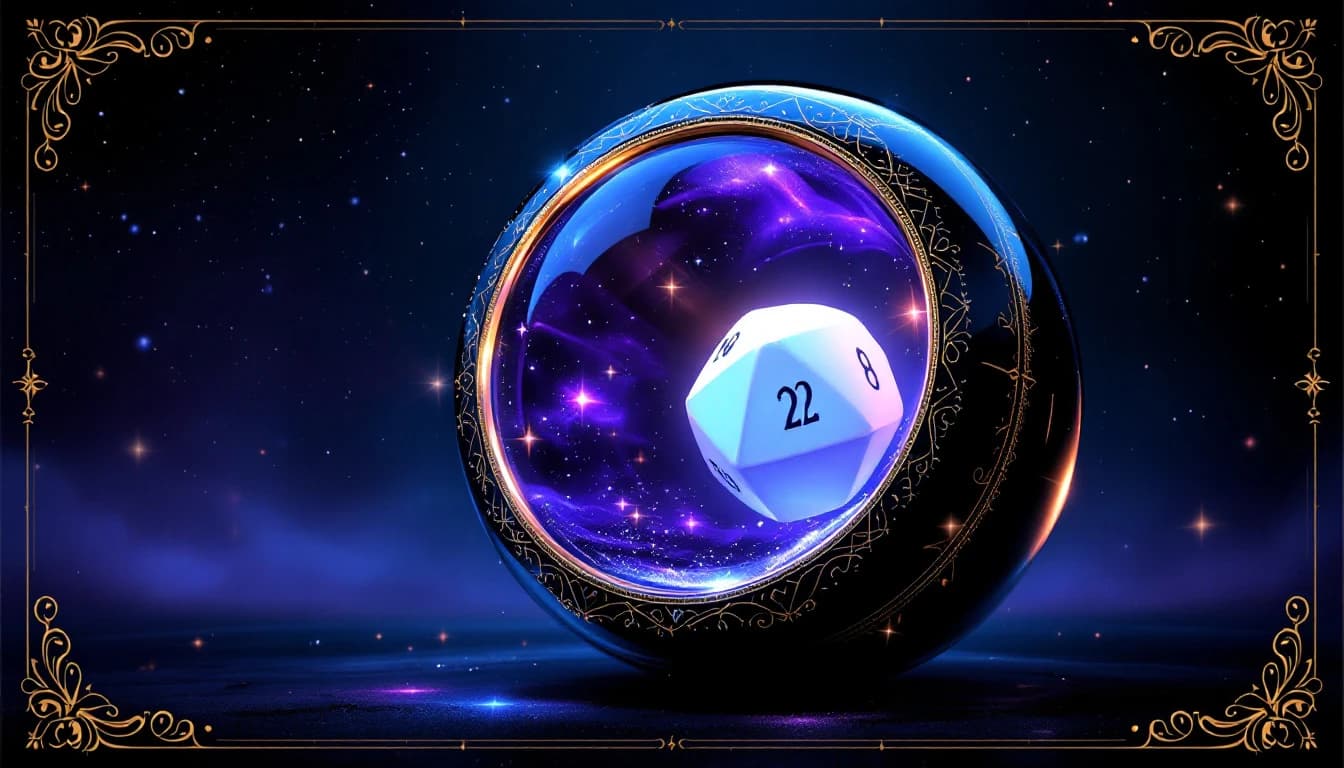
Short answer: there is no magic, no electronics, and no algorithm. A Magic 8 Ball is a 20-sided die floating in dark blue alcohol. When you turn the ball over, one face of that die drifts up against a small window and shows your answer. That is the entire mechanism — and once you see how the pieces fit, the way it works is genuinely clever. Here is what is happening inside, where it came from, and why a random toy can feel uncannily right.
Try the online Magic 8 Ball →Same 20 answers, same odds as the real toy — ask a question and watch one float up.What Is Inside a Magic 8 Ball?
Crack the glossy black shell open — people have, on camera, many times — and you find a surprisingly simple set of parts:
- A 20-sided die (a regular icosahedron). It is white plastic, and each of its twenty triangular faces carries one answer in raised letters.
- A cylindrical reservoir. The die does not float loose in the whole sphere; it sits in an inner tube that lines it up with the window.
- About 100 ml of dark blue alcohol. Alcohol is used instead of water because it is less likely to grow cloudy or freeze, and the deep blue dye hides the die until a single face settles flat against the glass.
- A viewing window. A small clear circle on the bottom of the ball, where the answer appears as white letters on a blue background.
That blue dye is the quiet hero. The die is white, the liquid is dark — so the only part you can read is the one face pressed right against the window, where its raised letters push the liquid aside. Every other answer stays lost in the murk.
How It Works, Step by Step
- You hold the ball with the window facing down, which lets the die float freely inside the alcohol.
- You ask a yes-or-no question and turn the ball so the window faces up.
- The die, being buoyant, floats toward the top — and one of its twenty faces lands flat against the window.
- The raised letters of that face displace the blue liquid, so the answer reads as crisp white text. You read it, and the reading is done.
Here is a detail almost no one knows: the original instructions actually told you not to shake the ball. Shaking whips air into the alcohol and leaves white bubbles across the window. In 1975 a new owner patented a small inverted funnel — the “Bubble Free Die Agitator” — that reroutes trapped air so the answer always comes up clean. The habit of shaking it stuck anyway, because shaking feels like part of the ritual.
“You were never supposed to shake it. Shaking makes bubbles — turning it over gently is how it was designed to work.”
A Short History: From Spirit-Writing to Toy Story
The Magic 8 Ball did not start as a ball at all. Its mechanism was invented in 1946 by Albert C. Carter, who was inspired by a spirit-writing device his mother — a Cincinnati clairvoyant — used in her readings. Carter and engineer Abe Bookman first sold it as a cylinder called the Syco-Slate.
- 1946: Carter files the patent and forms Alabe Crafts (from “Albert” and “Abe”) to sell the device.
- 1948: Bookman encases the mechanism in a crystal ball. It is not a hit.
- 1950: Chicago's Brunswick Billiards commissions a version shaped like a pool 8 ball — and the icon is born.
- 1975: Ideal Toy Company adds the bubble-free agitator that fixes the white-bubble problem for good.
- 1997: After passing through several owners, the brand lands with Mattel, which still makes it today.
Despite all those hands, the design has barely changed in over seventy years. By 2015, around a million Magic 8 Balls were still being sold every year — and the toy got its most famous cameo in Toy Story, where Woody asks if Andy will pick him over Buzz and the ball replies, “Don't count on it.”
Why the Answers Lean Positive
The twenty answers were not chosen at random. They were designed by Dr. Lucien Cohen, a psychology professor at the University of Cincinnati, and the split is deliberate: ten affirmative, five non-committal, and five negative. Because there are twice as many yes answers as no answers, a positive reply is genuinely twice as likely as a negative one. That is why the ball has always felt like it was quietly rooting for you.
Our online Magic 8 Ball keeps the exact same 10 / 5 / 5 weighting, so the odds you get on screen match the toy on the shelf. If you want the full list of phrases and where each one falls, see our guide to Magic 8 Ball questions and answers, or read what each of the 20 Magic 8 Ball answers actually means one line at a time.
Why a Random Answer Feels Right
If the answer is just one of twenty random lines, why does it so often seem to know something? Because the instant an answer appears, your own reaction shows itself. When the ball says “no” and your stomach drops, you just learned you wanted a yes. When it says “yes” and you feel relief, that was your gut agreeing all along. The toy does not predict anything — it gives your instinct a target to react against.
That is also why the Magic 8 Ball is a good fit for small, stuck decisions and a poor fit for serious ones. For medical, legal, financial, or safety questions, ask a qualified professional, not a toy. For “should I send the text” — shake away.
Ask the Magic 8 Ball now →You know how it works — now see what floats up. Free, instant, no sign-up.Frequently Asked Questions
- How does a Magic 8 Ball work?
- Inside is a 20-sided die floating in dark blue alcohol. Each face has one of 20 answers. When you turn the ball over, a face floats up against a small window and shows your answer. There are no electronics — it is pure buoyancy and contrast.
- What is the liquid inside a Magic 8 Ball?
- Roughly 100 ml of alcohol dyed dark blue. Alcohol keeps the die moving freely, and the dye hides every face except the one pressed against the window.
- Why does shaking it make bubbles?
- Shaking whips air into the alcohol. The original instructions warned against it; a 1975 patent added an internal funnel that reroutes the air, so modern balls clear up quickly.
- Who invented the Magic 8 Ball?
- Albert C. Carter invented the mechanism in 1946, inspired by his clairvoyant mother's spirit-writing device. Brunswick Billiards had it remade as an 8 ball in 1950, and Mattel has manufactured it since 1997.
Sources
- Magic 8 Ball — Wikipedia — internal mechanism (icosahedron, ~100 ml dyed alcohol, viewing window), the 10/5/5 answer split by Dr. Lucien Cohen, and ownership history.
- Encyclopaedia Britannica: Where Did the Idea for the Magic 8 Ball Come From? — Albert C. Carter and the spirit-writing inspiration behind the invention.
- University of Cincinnati: Abe Bookman created the everlasting Magic 8 Ball — Bookman's engineering role and the Alabe Crafts story.
- Adweek: Why the Magic 8 Ball Still Holds Our Fascination — roughly one million units sold per year as of 2015.
- U.S. Patent 4,049,277 — Bubble Free Die Agitator (1975) — the internal funnel that solved the white-bubble problem.