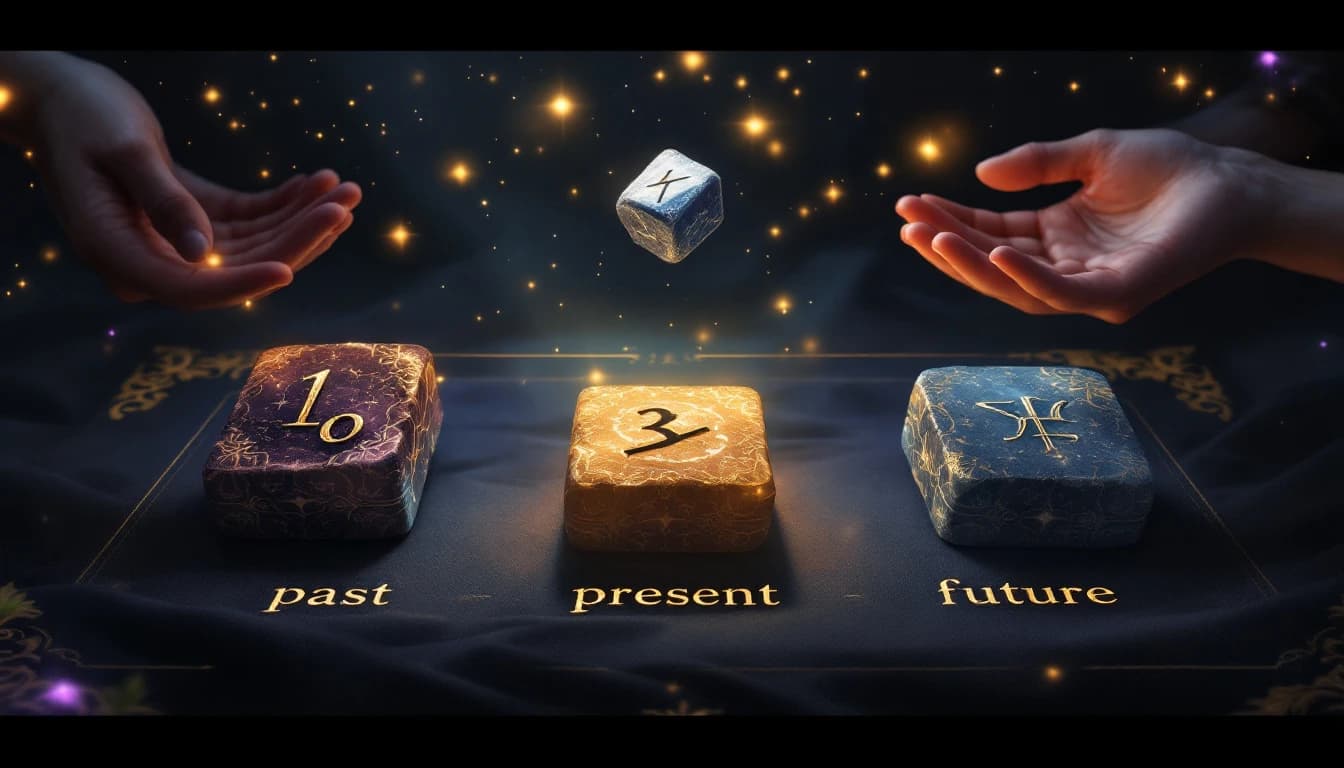
Short answer: you read runes by casting them and interpreting the symbols that land face-up, using a simple three-rune spread to answer one clear yes-or-no question. A single rune pull takes under five minutes and requires only a set of runes and a question in mind. What makes a reading clean is not the runes themselves but the clarity of the question — rune divination works best when you frame a focused decision you are already leaning on, let the symbols surface that lean, and listen to your own first reaction. This guide walks through your first reading in two simple methods, shows you how professional readers arrange runes into spreads, and explains what you are actually doing when a rune "falls."
Try the online rune reading →Ask one clear question and cast the runes. Free, instant, no sign-up needed.What Runes Actually Are
Runes are a set of 24 angular symbols, collectively called the Elder Futhark, that originated with Germanic and proto-Norse peoples between roughly 150 and 800 CE. The name "Futhark" comes from the sounds of the first six runes: Fehu, Uruz, Thurisaz, Ansuz, Raido, and Kenaz — similar to how we say "alphabet" from the first letters of the Greek alphabet. Each rune is a distinct mark with its own name and historically its own meaning.
For divination, the key insight is that rune casting is a form of reflection, not prediction. When you cast runes and read the symbols that land face-up, you are not being told the future by an external force. Instead, you are pausing with a question you already carry some feeling about, and the runes give that intuition a visible shape to react to. This is the same honest principle that explains how a pendulum works — the tool surfaces what you already sense but have not put into words.
“Runes don't reveal what you don't already know. They give your own intuition a clear symbol to see itself in.”
What You Need to Cast Runes
A rune set is straightforward to obtain and simple to use. Here are your main options:
- A physical rune set. Typically 24 stones or wooden tiles engraved with the Elder Futhark symbols. Sets usually cost 15 to 40 US dollars and come with a cloth pouch and a guidebook. They are widely available online and in shops that sell divination tools.
- DIY runes. If you prefer to make your own, you can carve or paint Elder Futhark symbols onto smooth pebbles, wooden tiles, or even write them on paper cards. Many readers find a self-made set carries more intention than a purchased one.
- An online rune reading. A digital rune casting removes the physical setup entirely — you ask a question and receive an instant reading with guidance on what the symbols mean. Useful when you want the ritual without owning a physical set.
Whichever you choose, keep your runes in a small cloth pouch or bag when not in use. Many practitioners prefer to store them with a small stone or crystal to keep them grounded. The setup matters far less than the focus you bring to the reading.
Your First Rune Reading: Single-Rune Pull (5 Minutes)
A single-rune pull is the fastest way to start. It gives you one clear symbol to anchor your answer and is complete in under five minutes. Here is how to do it:
- Hold your question clearly in mind. Think of one specific yes-or-no decision: "Should I reach out to them this week?" or "Is this the right time to make a change?" Write it down if it helps, or simply sit with it for a moment.
- Settle your focus. Take two or three slow breaths. You want a calm baseline before you pull — not anxious or distracted, just grounded and present.
- Reach into your rune pouch without looking. Shuffle your hand among the runes without peeking. Let your fingers wander for a few seconds, then draw one rune.
- Read the rune that lands face-up. Place it on a flat surface in front of you. Look up its meaning using your guidebook or our Elder Futhark meanings reference. The name and traditional meaning of the rune are your reading.
- Notice your first reaction. Before analyzing the symbol too deeply, what did you feel when you saw it? Relief? Resistance? Surprise? That flicker is usually the truest part of the reading.
A simple example: if you draw Dagaz (the rune of daybreak and clarity) while asking "Should I send the message?", the traditional reading suggests clarity and forward motion — a nudge toward yes. If you draw Isa (the rune of stillness and ice), the reading suggests the timing is not yet right — a no or a wait. The beauty of a rune pull is that the symbol gives your own intuition something concrete to anchor to.
The Three-Rune Spread: Past, Present, Future
Once you are comfortable with single pulls, the three-rune spread adds depth by showing the trajectory of a situation. This spread is named after the Three Norns of Norse mythology — Urd, Verdandi, and Skuld — who weave the threads of past, present, and future. It is the most widely used rune spread and works beautifully for bigger questions.
The layout: Sit with your question in mind. Draw three runes one by one and lay them out in a line from left to right. Each position has a specific meaning:
- First rune (left): Past. What has led to the current situation? What influences or root causes brought you to this question?
- Second rune (center): Present. What is the current state of affairs? What is actively happening or what do you feel right now about this decision?
- Third rune (right): Future. If the current path continues, what outcome is suggested? What comes next if you stay on this course?
How to read it: Once your three runes are laid out, read the story they tell together. Do not interpret each rune in isolation; look for the arc from left to right. A progression from a cautious rune to an active rune to a positive rune might suggest movement and resolution. A pattern of stillness runes might suggest the time is not yet ready. Your guidebook will give you the meaning of each symbol, but your job is to connect them into a narrative that speaks to your situation.
Cast the three-rune spread now →Ask your question and watch three runes surface. The pattern tells the story of what's moving.Two Ways to Cast Runes
Rune readers use two main methods for pulling or casting. Each has its own feel and can be used for both single pulls and multi-rune spreads:
Method 1: Bag Pull (Most Beginner-Friendly)
This is the simplest method and what most beginners start with. Hold your rune pouch closed, focus on your question, and reach in without looking. Draw one rune (or multiple, one at a time). The method is direct and requires no ritual setup — you can do it anywhere, even sitting in a chair with the pouch in your lap. Many readers prefer bag pulls because the randomness feels clean and honest.
Method 2: Scattering or Casting (More Traditional)
Scattering, also called casting, is the traditional method described in historical Germanic divination practice. Spread a cloth (usually white or a neutral color) in front of you, focus on your question, then gently toss your runes onto the cloth from above. Read only the runes that land face-up; any that land face-down are ignored. The physical act of scattering feels more ritualistic to many readers, and the randomness of how the stones fall can feel more removed from conscious choice.
Professional rune readers often use the scatter method because it feels more ceremonial and allows multiple runes to be read at once. Some readers combine both: they scatter a larger set and then pull clarifying runes from the pouch for runes that seem particularly important.
Tips for Your First Readings
Start with these practices to build confidence and clarity:
- One question at a time. Just like with a pendulum or crystal ball, runes answer best when you ask one clear decision, not multiple questions stacked together. "Should I take the job?" beats "What should I do about my career?"
- Be specific with your timing. "Should I call her this week?" is a stronger question than "Will things work out?" The tighter the frame, the clearer the rune's meaning becomes.
- Write down your reading. Before you flip through your guidebook, write down the runes you drew and your gut reaction to seeing them. Then check the meanings. You will often find your instinct matched the symbol's meaning closely.
- Do not ask the same question twice. If you cast runes and do not like the answer, resist the urge to immediately pull again. Let the answer sit with you for a day or two. If you still need clarity, ask a reframed question the next day.
- Use a guidebook you trust. Different authors offer slightly different interpretations of the runes. Find one that feels honest and aligned with your own sense of meaning, then stick with it for consistency.
Where to Learn the Rune Meanings
Each of the 24 Elder Futhark runes has a name, a sound, and a traditional meaning. For example, Fehu (cattle, wealth) traditionally represents abundance and resource, while Tiwaz (the god Tiwaz) represents justice and warrior energy. Learning these meanings is essential for reading runes.
Our detailed guide to Elder Futhark runes and their meanings covers all 24 symbols with historical context and modern interpretations. Bookmark it for reference during your early readings. Many physical rune sets also come with a printed guide, which is invaluable.
The most reliable modern authority on rune meanings is Ralph Blum's The Book of Runes (1982), which introduced modern rune divination to a wide audience and remains widely used by practitioners. His interpretations are thoughtful and grounded in historical lore while remaining accessible to beginners.
Is Rune Reading Accurate?
Rune reading is a tool for reflection, not prediction. The runes do not know the future and do not claim to. What runes do well is give your own intuition a visible symbol to react to. When you hold a question and see a rune surface, your first feeling — relief, resistance, or surprise — is usually the truest reading. The symbol simply made your own sense of the situation visible.
For medical, legal, financial, or safety decisions, consult a qualified professional, not a rune reading. Runes are genuinely useful for small, stuck, everyday crossroads — should I reach out, is this the right timing, do I need to rest more — and a poor fit for anything that matters more. Think of runes as a mirror you hold up to your own sense of a decision, not as an oracle standing outside you.
This is the same honest framing as crystal ball readings and the reason why, across all divination methods on this site, the accuracy of a reading depends far more on the question than the tool.
Read your runes now →Hold one clear question in mind and cast. The symbols that surface will show you what you already lean toward.Frequently Asked Questions
- How do you read runes for the first time?
- Hold one clear yes-or-no question in mind, settle your focus with a few breaths, reach into your rune pouch without looking, and draw one rune. Place it in front of you and read its name and meaning using a guidebook. Notice your first reaction before analyzing too deeply — that instinct is usually the truest part.
- What is the best rune spread for beginners?
- Start with a single-rune pull to build confidence. Once you are comfortable, move to the three-rune past-present-future spread, which is the most widely used and gives you a clear narrative arc. Both take just a few minutes and require no prior experience.
- How often should you cast runes?
- There is no rule. Some readers pull one rune daily for guidance, while others cast only when facing a specific decision. Avoid casting the same question twice in a short span — let an answer sit with you for a day or two before asking again, or ask a reframed question.
- Do I need to own a physical rune set to read runes?
- No. An online rune reading gives you the same insight — you ask a question and receive a reading with guidance on what the symbols mean. The mechanism is your own intuition reacting to a symbol, which works just as well on a screen as it does with physical stones.
Sources
- Runes — Wikipedia — the Elder Futhark alphabet (24 symbols, 150–800 CE), the historical evidence for Germanic divination practices (Tacitus, 1st century), and the modern development of rune divination systems.
- Runic divination — Wikipedia — the historical context of rune casting in Germanic and Norse traditions, Tacitus's description of lot-casting divination, and how modern systems were developed in the 19th and 20th centuries.
- Encyclopaedia Britannica: Rune — the origin and history of runes as a writing system and divination tool among Germanic peoples, and their use across Northern European cultures.
- Encyclopaedia Britannica: Norns — the three Norns (Urd, Verdandi, Skuld) of Norse mythology who weave the threads of fate, the origin of the naming for the three-rune past-present-future spread.