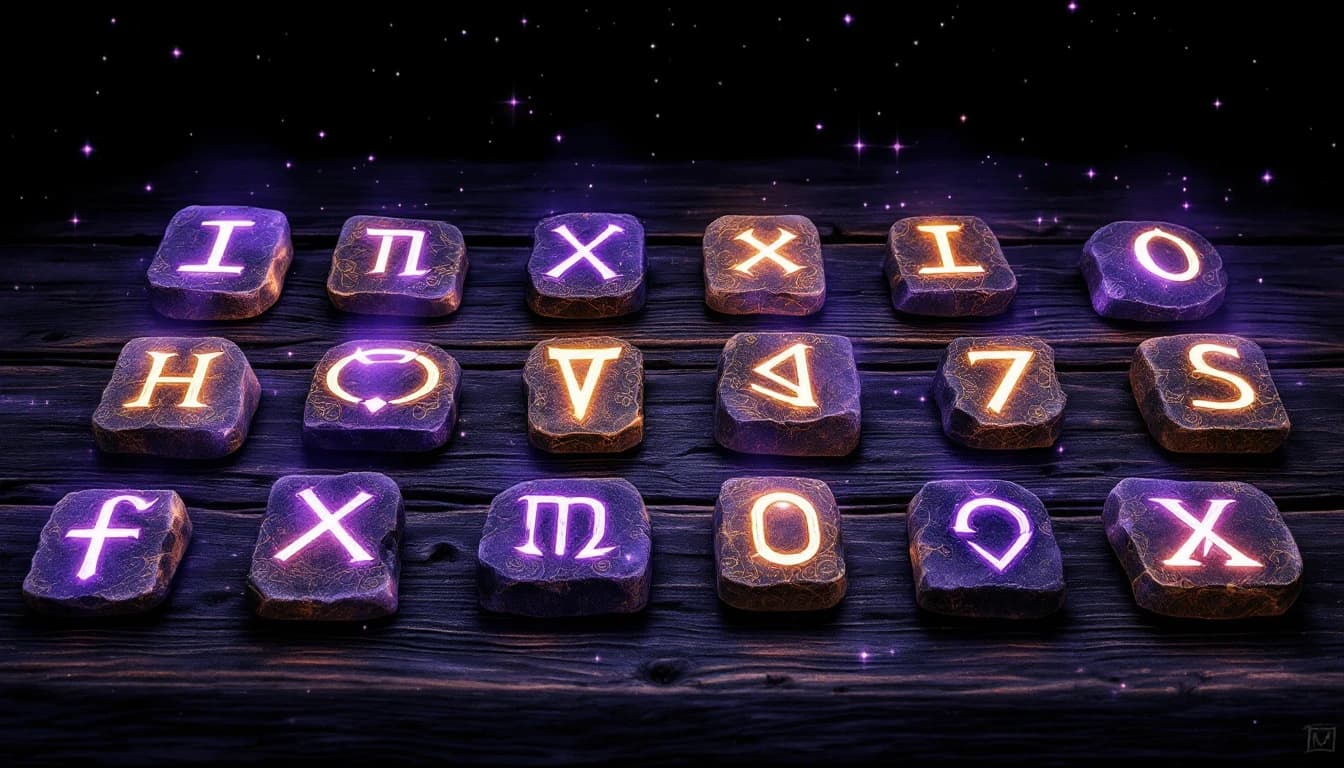
Short answer: the Elder Futhark is a 24-rune alphabet used by Germanic peoples from the 2nd to 8th centuries, organized into three families (aettir) where each rune carries a name, sound, and upright meaning. This guide lays out all 24 runes in their three groups with names, phonetic values, and how to read them in a divination spread. Unlike most rune sites that bury the full alphabet across a dozen pages, this is the single scannable reference every other rune article points to — your cornerstone for understanding what each symbol means when it appears in your spread.
Cast the runes now →Draw your runes and read their meanings. Ask one clear question, pull your cast, interpret.What the Elder Futhark Is
The Elder Futhark is the oldest form of the runic alphabet, used as a writing system by Germanic peoples across what is now Scandinavia and northern Germany during the Migration Period — roughly the 2nd through 8th centuries. Unlike Latin letters, each of the 24 runes represents both a sound (its phonetic value) and a concept or force (its symbolic meaning). The word “Futhark” itself comes from the first six runes: Fehu, Uruz, Thurisaz, Ansuz, Raido, and Kauna — exactly like how “alphabet” comes from Alpha and Beta.
In divination, runes function as reflection tools, just like a pendulum or crystal ball. When you pull a rune, you are not receiving a prophecy — you are pulling a mirror. The symbol and its meaning prompt your own intuition to surface an answer you have already been sensing. This is the same honest principle that explains how a pendulum works or how crystal gazing functions — the tool is a lens, not a fortune-teller. Used that way, for reflection on a question you are genuinely stuck on, rune reading is genuinely helpful. Used as prediction of the future, rune reading is a poor fit.
“A rune pulled is not a fortune told. It is a mirror held up to a question you are already carrying.”
The Three Aettir (Families)
All 24 Elder Futhark runes are organized into three groups of eight, known as the aettir (pronounced “eye-teer”). The word aett is Old Norse for “family” or “clan,” and each group takes its name from the first rune in that family. This structure was originally a mnemonic device — a practical way to remember and teach 24 symbols by breaking them into three smaller, manageable families. Below is every rune, its name, its sound, and its upright reading meaning.
Freyr's Aett (Runes 1-8): Creation, Wealth, and Will
The first aett is associated with creation, movement, wealth, and personal will. These runes tend to read as active, generative forces.
- Fehu (ᚠ, /f/) — Cattle, wealth. Upright reading: abundance, success, new beginnings, movable wealth. In a spread, Fehu often signals gain, resources flowing toward you, or the start of a prosperous cycle. Reversed, it warns against greed or stagnation.
- Uruz (ᚢ, /u/) — Aurochs (wild ox). Upright reading: primal power, strength, untamed force, endurance. Uruz appears when a situation calls for raw energy or when you need to draw on your deepest reserves. It is the rune of the wild, unbroken self.
- Thurisaz (ᚦ, /θ/) — Giant, monster, thorn. Upright reading: conflict, protection, a challenge or obstacle that sharpens you. Thurisaz is not always gentle — it represents resistance that forces growth, or a threshold you must cross.
- Ansuz (ᚨ, /a/) — God, ancestor. Upright reading: communication, wisdom, clarity, the voice of authority. Ansuz often signals a message arriving, a truth becoming clear, or ancestral knowledge stepping forward. It is the rune of the word spoken and heard.
- Raido (ᚱ, /r/) — Ride, journey. Upright reading: travel, movement, forward motion, alignment. Raido suggests a road you are on or about to take, and whether that road is smooth or rough. It is the rune of motion and rhythm.
- Kauna (ᚲ, /k/) — Boil, sore, opening. Upright reading: passion, creativity, controlled fire, transformation through heat. Kauna is the rune of inner fire and the creative force that burns away old forms to birth new ones.
- Gebo (ᚷ, /ɡ/) — Gift, exchange. Upright reading: generosity, partnership, fair exchange, reciprocity. Gebo is symmetrical and balanced — it reads as a gift freely given and received, or a bond of mutual benefit.
- Wunjo (ᚹ, /w/) — Joy, delight. Upright reading: happiness, harmony, light, wish-fulfillment. Wunjo is the rune of relief and the return to ease after struggle. It often marks the end of a difficult cycle and the start of peace.
Heimdall's Aett (Runes 9-16): Change, the Unconscious, and Transformation
The second aett deals with change, the underworld, the unconscious mind, and the forces that move beneath the surface. These runes often read as more mysterious, introspective, or challenging.
- Hagalaz (ᚺ, /h/) — Hail, disruption. Upright reading: sudden change, disruption, necessary upheaval, the hailstone that cracks the ice. Hagalaz is the rune of unexpected events and the wake-up call that forces transformation. It is not gentle, but it is often clarifying.
- Naudiz (ᚾ, /n/) — Need, necessity, constraint. Upright reading: hardship, limitation, the fuel of survival, unavoidable difficulty. Naudiz appears when you are in a tight place, but it also reminds you that constraints are where strength is forged.
- Isaz (ᛁ, /i/) — Ice, stillness. Upright reading: pause, stasis, crystalline clarity, a moment frozen in time. Isaz reads as a necessary stop, a place where movement halts so you can see clearly. It is the rune of the held breath.
- Jeran (ᛃ, /j/) — Year, harvest, cycle. Upright reading: completion, harvest, natural rhythm, the turning of the year. Jeran appears when a cycle has completed and reward is ready to be reaped. It is the rune of seasons turning and work bearing fruit.
- Eihwaz (ᛇ, /æː/) — Yew-tree, axis. Upright reading: resilience, the sacred axis, endurance through change, connection to the roots. The yew is one of the oldest trees and one of the hardest — Eihwaz reads as deep strength, grounding, and the ability to bend without breaking.
- Perþo (ᛈ, /p/) — Secrets, unknown fate. Upright reading: mystery, hidden knowledge, chance, the unknowable future. Perþo is the rune of what lies beneath the surface, what you do not yet understand. It reads as secrets, intuition, or the need to trust what you cannot yet see.
- Algiz (ᛉ, /z/) — Elk, protection. Upright reading: protection, defense, divine connection, alertness. Algiz is a shield rune — it reads as safety, the presence of a guardian, or the need to raise your defenses. It is also the rune of reaching upward to the sacred.
- Sowilo (ᛊ, /s/) — Sun, energy, clarity. Upright reading: success, energy, breakthrough, illumination. Sowilo is pure light — it reads as clarity emerging, obstacles burning away, and the warmth of triumph. It is the rune of the sun at full strength.
Tyr's Aett (Runes 17-24): Society, Self, and Spiritual Evolution
The third aett concerns society, the self within community, spiritual matters, and the evolution of consciousness. These runes often read as wisdom-bearers and guides through the human journey.
- Tiwaz (ᛏ, /t/) — Tiwaz (god of war and justice). Upright reading: justice, victory through righteousness, sacrifice for the greater good, warrior spirit. Tiwaz is the rune of the truth-teller and the one willing to stand for what is right, even at cost.
- Berkanan (ᛒ, /b/) — Birch-tree, growth. Upright reading: renewal, purification, new birth, gentle growth. The birch is the first tree to green after winter — Berkanan reads as healing, fresh beginnings, and the nurture required for new life to flourish.
- Ehwaz (ᛖ, /e/) — Horse, movement paired. Upright reading: partnership, trust, matched motion, transport. Ehwaz is a rune of pairs and rhythm — it reads as two moving together in sync, or the trust required to move as one.
- Mannaz (ᛗ, /m/) — Man, human, self. Upright reading: the self, humanity, community, cooperation, the logical mind. Mannaz reads as you, your place in the human order, and your ability to think, reason, and connect with others. It is the rune of civilization and the rational self.
- Laguz (ᛚ, /l/) — Water, liquid, flow. Upright reading: intuition, flow, the unconscious, emotions, life-force. Laguz is the rune of what flows, what feels, what moves beneath the surface. It reads as the pull of emotion or intuition, the current beneath logic.
- Ingwaz (ᛜ, /ŋ/) — Ing (fertility deity), completion. Upright reading: fertility, completion of a cycle, the seed becoming manifest, closure. Ingwaz often reads as the full ripeness of something — a project finished, fertility arriving, the end of one season and readiness for the next.
- Dagaz (ᛞ, /d/) — Day, light, breakthrough. Upright reading: awakening, transformation, the turning point, light breaking through. Dagaz is the rune of the moment when night becomes day — it reads as breakthrough, new understanding, the veil lifting.
- Othala (ᛟ, /o/) — Inheritance, household, ancestral property. Upright reading: home, heritage, ancestral gifts, the foundation you stand on. Othala is the rune of roots, legacy, and what you inherit from those who came before. It reads as family, belonging, and the security of solid ground beneath you.
How to Read Runes in a Spread
A rune reading is simple to set up but honest to interpret. Here is the basic method:
- Hold one clear yes-or-no question in mind. “Should I take this offer?” works. “What does my future hold?” is too open. Runes, like a pendulum, read best when you ask a specific question they can actually answer.
- Pull one, three, or more runes. A single rune gives a direct answer. Three runes (past, present, future or situation, action, outcome) give depth. There is no fixed rule — pull as many as feel right.
- Note which way each rune lies. Upright (point up) carries its full meaning. Reversed (upside-down) often softens or inverts the meaning — Fehu reversed might read as loss rather than gain, or delayed arrival rather than arrival now.
- Read each rune in the context of your question. Use the meanings above as a starting point, but trust your own intuition about what each rune reflects in relation to what you asked. If Jeran pulls for “should I stay or leave,” it might read as a cycle completing, pointing toward a change.
- Notice your first feeling when the rune lands. Before you think about the meaning, what did you feel? Relief, dread, surprise? That flicker is often the real answer — the rune simply gave your own sense a clear yes, no, or maybe to react to.
If you want to see a guided rune reading in action — pull, cast, and read the meaning all at once — our free runes reading tool walks you through one in moments. It is the same method, just digital and immediate.
Cast your runes now →Ask one clear question, pull your runes, and read what surfaces. Free, no sign-up needed.Elder Futhark as Alphabet vs. Divination Tool
The Elder Futhark began as a practical writing system — each rune was a letter, assigned a sound that let speakers of Old Norse and other Germanic languages write words. The earliest complete sequential listing appears on the Kylver Stone from Gotland, Sweden, dated around 400 AD. This stone shows the 24 runes in a deliberate order, suggesting they were taught and memorized in precisely this sequence.
In modern divination, we use these same 24 symbols, but we are not writing words. Instead, each rune's name and the force it represents become a prompt for reflection. When you pull Laguz, you are not spelling out a sound — you are pulling the concept of water, flow, intuition, and emotion, and asking how that concept speaks to your question. This shift from letter to symbol happened gradually, but by the time runes appeared in medieval texts focused on divination, the practice was well-established. For a deeper dive into how other rune traditions work, see our guide on how to read runes or the extended meanings for each rune.
Why Runes Are Reflection Tools, Not Predictions
A rune reading is a tool for reflection, not forecast. When you pull a rune, the symbol does not change the future — it clarifies where you already stand. If Dagaz pulls when you ask whether to leave a stuck situation, it might read as “yes, this is the moment of breakthrough.” But that reading is not the rune predicting the future; it is the rune offering you a mirror. Your own sense — the flicker you felt when it landed — is what tells you whether that mirror is true for your situation.
For decisions about your health, your legal standing, your safety, or your financial future, ask a qualified professional, not a rune spread. Notice, too, your first reaction when a rune lands: relief, resistance, surprise. That reaction is usually the truest part of the reading. The rune simply gave your intuition a clear symbol to speak through. It is the same honest mechanism behind every method on this site — whether you crack open a fortune cookie or shake a Magic 8 Ball, the prompt is neutral and the meaning is yours.
Pull a rune for clarity →You know all 24 meanings now — cast a reading and see what emerges for your question.Frequently Asked Questions
- What is the difference between Elder Futhark and other runic alphabets?
- The Elder Futhark is the oldest runic system, used from roughly the 2nd to 8th centuries. Later versions like the Younger Futhark (used in Scandinavia after the 8th century) have fewer runes and different shapes. Most modern rune divination uses the Elder Futhark because it is the most complete and historically documented system, with 24 runes covering the full spectrum of Germanic sounds and concepts.
- Why are there exactly 24 runes in the Elder Futhark?
- Each of the 24 runes represents a phoneme (sound) in the Germanic languages of the 2nd to 8th centuries. The number reflects the sounds that speakers of Old Norse and related tongues needed to write. The three aettir (families of eight) were likely an organizational tool for teaching and memorizing the system, since eight is an easier number to retain than 24.
- Can runes predict the future?
- No. Runes are a reflection tool, not a prediction tool. A rune reading clarifies what you are already sensing or sensing about a question you are stuck on. The real answer comes from your own intuition — the rune simply gives that intuition a symbol to react to. For predictions or guidance on serious decisions, ask a qualified professional.
- What does it mean if a rune pulls reversed?
- A reversed rune typically softens, inverts, or delays the meaning of its upright form. For example, Fehu reversed might read as delayed wealth or loss instead of immediate gain. Some readers ignore reversals and read only upright runes, while others use them for nuance. Work with whichever approach feels most honest to you.
Sources
- Elder Futhark — Wikipedia — the complete historical record of all 24 runes, their names, phonetic values, meanings, the Kylver Stone (c. 400 AD) as the earliest sequential listing, and the three aettir structure used for teaching and divination.
- Labyrinthos: Elder Futhark Rune Meanings List — a comprehensive modern reference for all 24 Elder Futhark runes with upright and reversed meanings used in contemporary rune divination practice.
- Norse Path: Elder Futhark — detailed historical and cultural context for the Elder Futhark, the three aettir families, and how the runes were used both as a writing system and divination tool across Germanic cultures.
- Kylver Stone — Wikipedia — the earliest known sequential listing of all 24 Elder Futhark runes, dated around 400 AD from Gotland, Sweden, providing the historical anchor for the rune order and complete set.